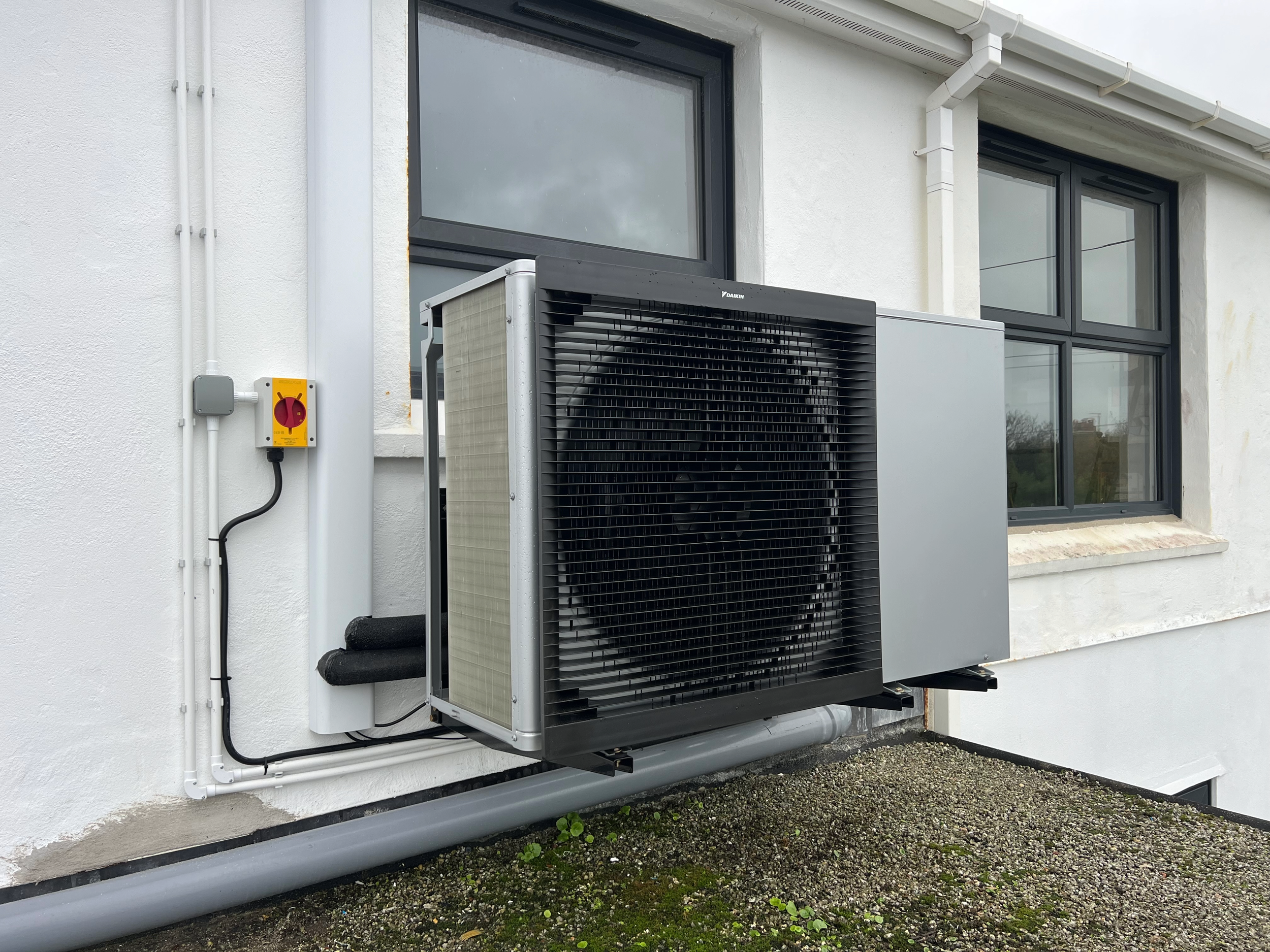
The 100 Year Old Newquay Town House
I hear it very often, ‘my home is very old, would a heat pump even work?’ We’re talking about a classic century-old Newquay town house: solid brick walls, massive original windows, and a total heat loss that would make most installers run a mile.
But here’s the thing: heat loss is just a number. It doesn't matter if a house was built in 1924 or 2024; the physics of heating stays exactly the same. You just have to replace the energy the building loses.
The Challenge: Single Skin Walls and Big Windows
Because this house has "single-skin" solid walls, it loses heat much faster than a modern cavity-wall home. Cavity walls create an air pocket that breaks the transfer of heat between the inside and outside air. The massive windows don't help either, they’re basically giant magnets for the cold. To make this work, we had to be incredibly precise with the engineering.
The "Lid on the Cup" analogy
Before we touched the heating, we made sure the fundamentals were in place. I always tell clients: you need double glazing and at least 200mm of loft insulation. It’s like putting a lid on a coffee cup. Without that "cap," the heat pump is just fighting a losing battle against the sky. This particular customer opted for 300mm insulation which helped a lot. Because heat rises, if you put a ‘lid’ onto the house, it stops the heat escaping into the air outside.
The Engineering: Low and Slow
The secret to this job was running the system at 43°C. Most people are used to a boiler blasting the radiators at 70°C for an hour and then switching off. We did the opposite. We set this up, as everyone should with an ASHP, to run "low and slow."
To get enough heat out of 43°C heating system in this house, we installed larger radiators. It’s all about surface area, meaning more metal on the wall means we can deliver all that required heat without needing the water to be scalding hot. These radiators are designer vertical radiators in living areas, and triple (or K3) in areas we could afford to put them.
The Pipework "Motorway" (and the One-Pipe Problem)
One question I get asked all the time is: "Do I have to rip up all my floorboards?" Usually, we try to work with what’s there, but this house had an old one-pipe system.
Think of your pipework like a motorway. In a modern "two-pipe" system, every radiator has its own exit and entry to the motorway. In an old one-pipe system, all the radiators are essentially sharing a single, slow lane. For a heat pump to work efficiently at 43°C, you need high flow rates—you need multiple lanes to move that thermal energy.
Since the customer was doing renovation works anyway, it was the perfect time to bite the bullet. We stripped out the old one-pipe arrangement and installed a proper two-pipe circuit. This ensured the heat pump could deliver the right volume of water to those new, larger radiators. Without that change, we never would have hit the efficiency targets the house needed.
The Result: 400% Efficiency
By sticking to these fundamentals and stabilising the envelope, sizing the rads for the actual heat loss, and fixing the hydraulic "bottleneck"—we achieved an efficiency of over 400%.
That means for every 1kW of electricity the owner pays for, they get 4kW of heat into the house. Even with those 100-year-old walls and big windows, the house stayed at a steady 20°C all winter.
It just goes to show: if the engineering is right, the age of the house doesn't matter.